Related

Why We Do Gymnastics In CrossFit (And Why You Should Care About Getting Better At It)
Let me guess. At some point you've watched someone do a ring muscle-up and thought one of two things.
Either: I want to do that someday. Or: That will never be me.
Maybe both, back to back.
Here's what I want you to understand before we go any further — the muscle-up isn't the point. The muscle-up is just a destination that proves the journey happened. The journey is what actually matters, and it starts somewhere a lot more familiar than you might think. It starts with a push-up. It starts with a bodyweight squat. It starts with hanging from a bar and figuring out how to move your own body through space.
That's gymnastics in CrossFit. And it's one of the most important things we do.
What We Actually Mean By "Gymnastics"
When CrossFit uses the word gymnastics, we're not talking about leotards and balance beams. We're talking about something more fundamental: the ability to control your own body. To move it with intention, efficiency, and awareness. To express strength relative to your own bodyweight.
CrossFit's methodology is built on three training modalities: gymnastics, weightlifting, and monostructural metabolic conditioning — your running, rowing, and biking. Gymnastics is the bodyweight pillar of that framework. And within it lives a spectrum of movements that range from the most foundational patterns a human body can perform all the way up to skills that require months or years of deliberate practice.
That spectrum looks something like this:
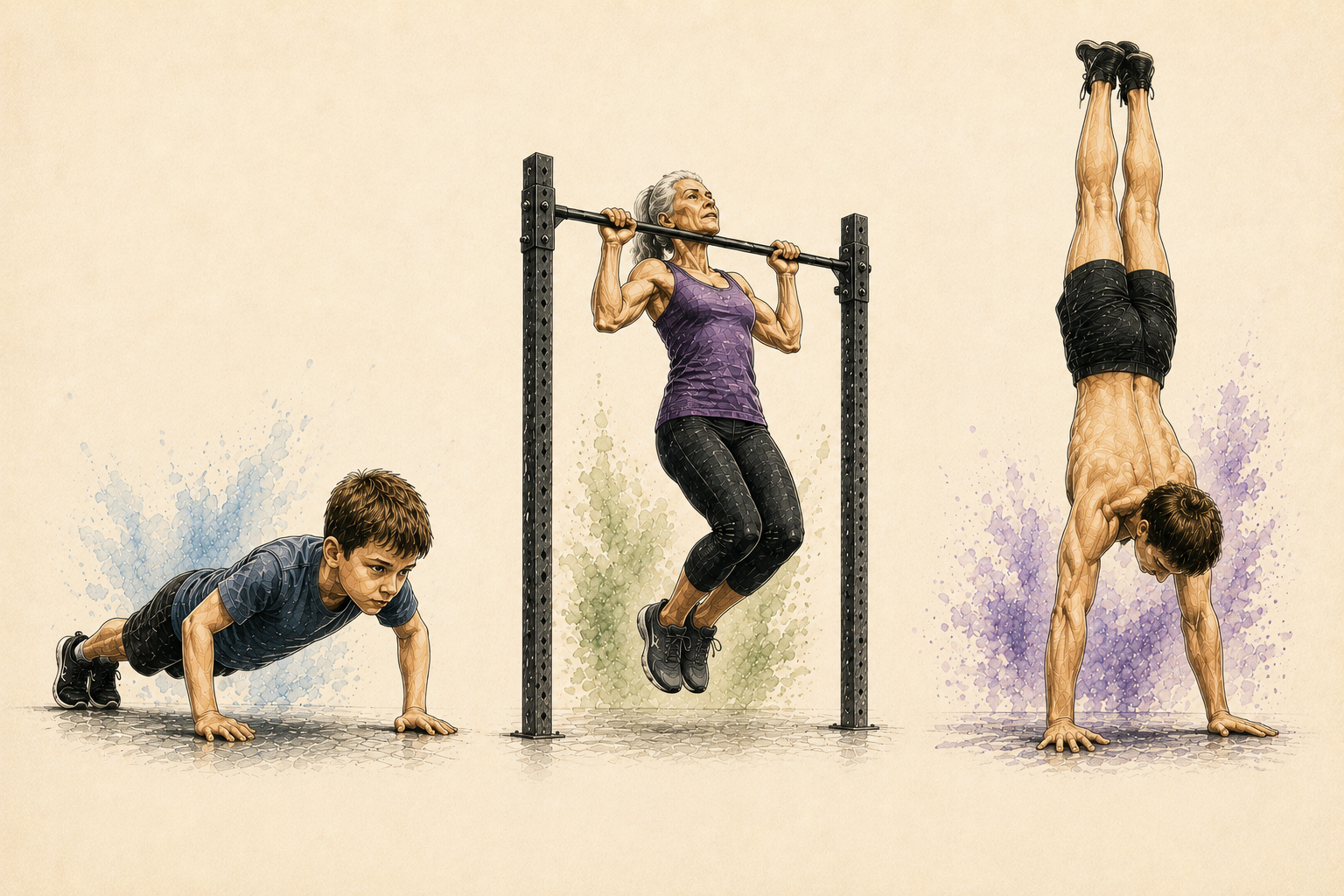
Foundation: Bodyweight squats, push-ups, sit-ups, hollow body holds, planks
Building: Ring rows, jumping pull-ups, banded pull-ups, dips, knees-to-chest
Intermediate: Strict pull-ups, chest-to-bar pull-ups, toes-to-bar, handstand holds, box jump variations
Advanced: Kipping pull-ups, bar and ring dips, L-sits, rope climbs, handstand push-ups
Elite: Bar and ring muscle-ups, strict handstand push-ups, pegboard climbs, advanced ring work
Every single one of these movements belongs in the same family. And every single one of the advanced skills is built directly on the foundations beneath it. There are no shortcuts — and that's not a limitation. That's actually the whole lesson.
Why Body Control Is A Long-Term Investment
Here's a question worth sitting with: when does your ability to control your own body actually matter?
The obvious answer is in the gym. But the real answer is everywhere.
It matters when you slip on ice and your body instinctively corrects before you hit the ground. It matters when you're climbing a ladder, carrying a load up stairs, or lifting something awkward and heavy out of a truck bed. It matters when you're playing with your kids on the floor, chasing them at the park, or spotting them at the top of a jungle gym. It matters at 40, and at 60, and at 80 — maybe especially then.
The ability to control your body through space — to know where it is, to move it with intention, to stabilize it under load — is one of the strongest predictors of quality of life as you age. Fall risk alone is one of the leading causes of injury-related death in older adults. The people who can catch themselves, who have the strength and coordination to react, are the ones who trained that capacity long before they needed it.
Gymnastics training does that. Systematically. Progressively. At every fitness level.
What Each Layer Of The Ladder Actually Develops
This isn't arbitrary. Every movement on the gymnastics spectrum is developing something specific that feeds upward into the next level.
The push-up builds pressing strength, yes — but more importantly, it teaches your body to create and maintain full tension from head to toe. A strict, solid push-up requires a braced core, active glutes, packed shoulders, and a rigid midline. Done correctly, it's a moving plank. That full-body tension is the same tension required to do a dip, a handstand push-up, or a muscle-up. The push-up is the foundation of all of them.
The bodyweight squat is the movement pattern your hips, knees, and ankles were designed for. Before you ever touch a barbell, your squat needs to be solid — mobile at the bottom, stable throughout, controlled on the way down and powerful on the way up. The athletes who struggle with barbell squats almost always have an unresolved bodyweight squat pattern. Fix the pattern, and the load takes care of itself.
The pull-up develops pulling strength and scapular control — two things that most people are dramatically underdeveloped in, because modern life involves almost no pulling. We push doors open. We push off chairs. We press. The pull is neglected. Pull-ups address that imbalance and build the posterior shoulder and upper back strength that protects your joints for decades.
Dips develop the tricep and shoulder stability that translates into every pressing movement and eventually into the transition phase of a muscle-up. They also train your ability to support your bodyweight through a full range of motion — a capacity that has obvious real-world carry-over.
The L-sit is a masterclass in core compression strength. It's not about six-pack aesthetics. It's about the ability to create tension through your entire anterior chain — hip flexors, abs, quads — while holding position. That compression strength shows up in every overhead movement, every gymnastics skill, and every time your spine needs to resist force.
Rope climbs are one of the most complete upper body movements in CrossFit. Grip, pulling strength, leg drive, coordination, and the mental focus to keep moving when your forearms are screaming — rope climbs train all of it. They also develop a kind of full-body tension that very few other movements can replicate.
The muscle-up — bar or ring — is where all of it comes together. The pull-up strength. The dip strength. The grip. The timing. The body tension. The coordination to link a pull and a push into one fluid transition. You cannot fake a muscle-up. It either happens or it doesn't, and when it does, it's because the work beneath it was done.
Why Progressions Are The Whole Game
Here's where I want to be direct with you: skipping progressions doesn't save time. It borrows time from the future.
When someone tries to kip their way to a pull-up before they have strict pulling strength, they're building a movement pattern on a cracked foundation. When someone attempts ring muscle-ups without solid bar muscle-ups first, they're adding instability to a skill that isn't stable yet. The result is usually a plateau — or worse, an injury — that takes longer to address than the progression would have taken in the first place.
The progression ladder exists because that's how motor learning actually works. Your nervous system needs to own a skill at one level before it can build the next one on top of it. Each step earns the next. And the athletes who trust the process — who don't rush the strict work, who don't skip the drills, who put in the reps at the level they're actually at — are the ones who end up with durable, lasting skills that don't break down under fatigue or pressure.
There is no shame in being at the beginning of the ladder. Every single person in your gym started there. The only thing that determines how far up you go is how consistently you show up and do the work at the level you're on today.
What This Looks Like In Our Gym
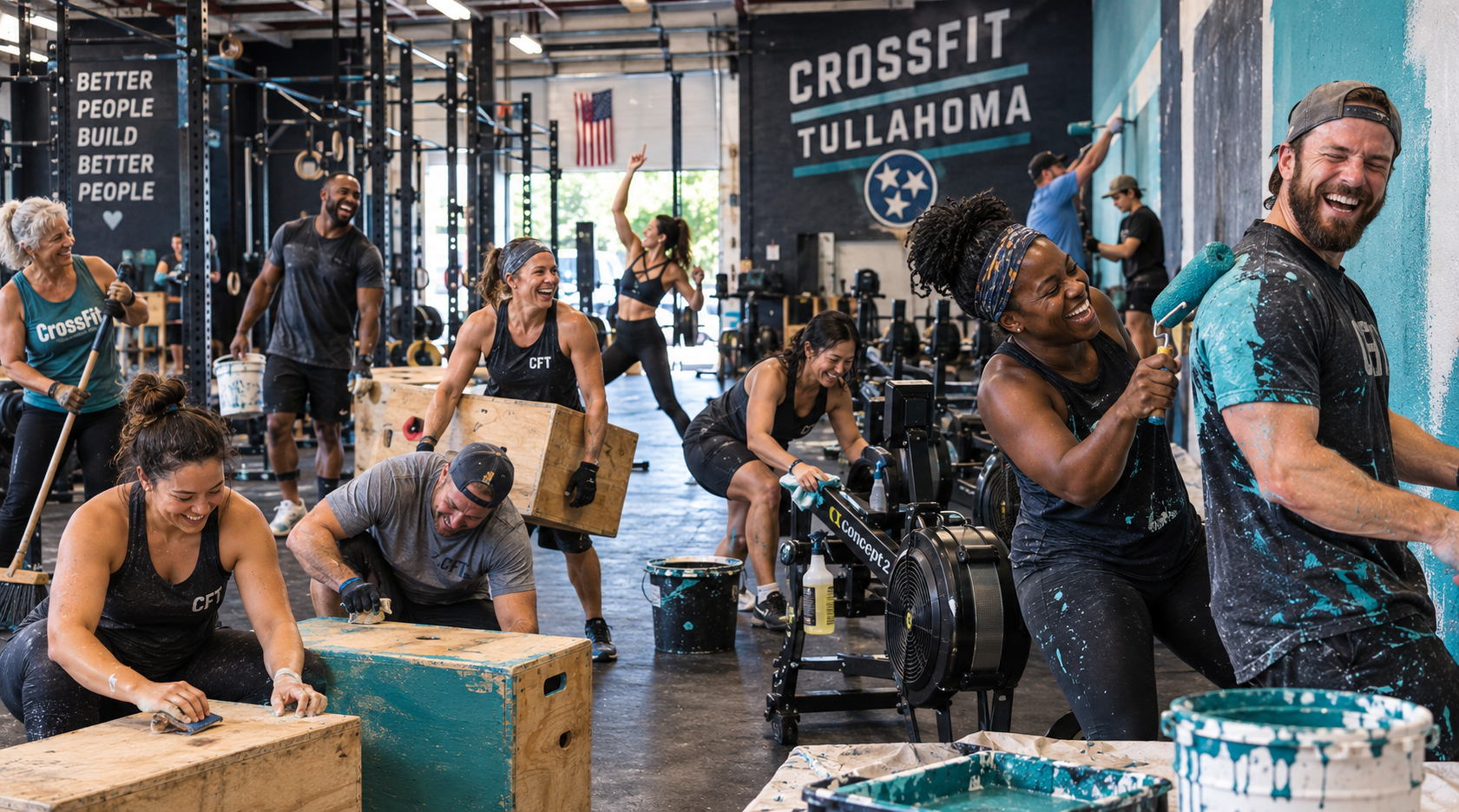
At CrossFit Tullahoma, we program gymnastics across all of these levels because our members are at all of these levels — and because we believe every person who walks through our door deserves to get better at controlling their own body, regardless of where they're starting.
If a workout calls for pull-ups and you're working on a banded progression, that's not a modification. That's the program. That's the work that's going to get you to strict pull-ups, which is going to get you to chest-to-bar, which is eventually going to make a muscle-up possible for you if that's where you want to go.
We'll meet you where you are. We'll show you what's next. And we'll put in the reps with you.
[STORY PLACEHOLDER — a member who worked through a gymnastics progression — pull-ups, muscle-up, rope climb, etc. — and what that journey looked like and meant to them]
The goal isn't to make you a gymnast. The goal is to make you someone who can move their body with confidence, strength, and control — for the rest of your life. Gymnastics is how we build that. One progression at a time.
Kodi Lovelace is a Coach at CrossFit Tullahoma, located in Tullahoma, TN. He's passionate about helping everyday people build lasting health through smart, varied, and sustainable fitness. If you have questions or want to learn more, reach out at crossfittullahoma.com and follow on Instagram @kodilovelace and @cftullahoma
Tags: CrossFit Tullahoma, CrossFit gymnastics, pull-ups CrossFit, muscle-up progression, bodyweight fitness, functional movement, CrossFit skills, gymnastics for adults, fitness Tullahoma TN