Related

CrossFit After 40: Why This Might Actually Be the Best Time to Start
Somewhere along the way, a lot of people in their 40s and 50s picked up a story about themselves.
The story goes something like this: I'm past my prime. My best athletic years are behind me. I have too many old injuries, too many responsibilities, and too little time. Maybe fitness was something I should have prioritized in my 20s and 30s. It's probably too late to start something like CrossFit now.
I've heard some version of that story more times than I can count. And I want to dismantle it — not with empty encouragement, but with honest context about what's actually happening in your body at this stage of life and why CrossFit is one of the most well-suited training tools available to address it.
The truth is that your 40s might be the most important decade to get serious about your fitness. Not in spite of your age. Because of it.
What's Actually Happening in Your Body After 40
Let's be honest about what's going on physiologically, because understanding it is what makes the case for training so compelling.
Starting around your mid-30s and accelerating through your 40s, your body begins losing muscle mass at a rate of roughly 1-2% per year if you're sedentary. This process — called sarcopenia — is one of the most significant contributors to the physical decline most people associate with "just getting older." Less muscle mass means slower metabolism, less strength, reduced bone density, higher injury risk, and less capacity to do the things you want to do in daily life.
Alongside that, cardiovascular capacity starts to decline. Recovery takes longer. Hormonal shifts — declining testosterone in men, changing estrogen and progesterone levels in women — affect energy, body composition, sleep quality, and mood. Joint mobility that was never trained tends to become more limited. And if you've spent the last two decades sitting at a desk, those effects are compounded.
None of that is inevitable. Almost all of it is trainable.
The research on this is consistent and clear: adults who engage in regular strength and cardiovascular training can dramatically slow — and in many areas reverse — the physical decline associated with aging. Muscle mass can be built at any age. Cardiovascular capacity can improve at any age. Mobility can be recovered. Bone density responds to load. The body is more adaptable than most people believe, and it remains adaptable well into your 40s, 50s, 60s, and beyond.
The question isn't whether your body can respond to training at 40. It can. The question is whether you're going to give it the right stimulus.
Why CrossFit Is Specifically Designed for This
CrossFit's methodology — constantly varied, functional movement, at appropriate intensity — addresses every single one of those age-related physical concerns in a single program. That's not a coincidence. It's what the methodology was designed to do.
The varied modalities mean your cardiovascular system, your muscular strength, your mobility, and your coordination are all getting trained consistently. You're not neglecting one system while overdeveloping another. You're building the kind of complete, durable fitness that directly counters the specific ways the body declines with age.
The functional movements mirror the demands of real life. Squatting, hinging, pressing, pulling, carrying — these are the patterns that determine whether you can get off the floor without help at 70, carry groceries without pain, play with your grandchildren without sitting it out. CrossFit trains these patterns intentionally, which means every hour in the gym is an investment in your actual quality of life.
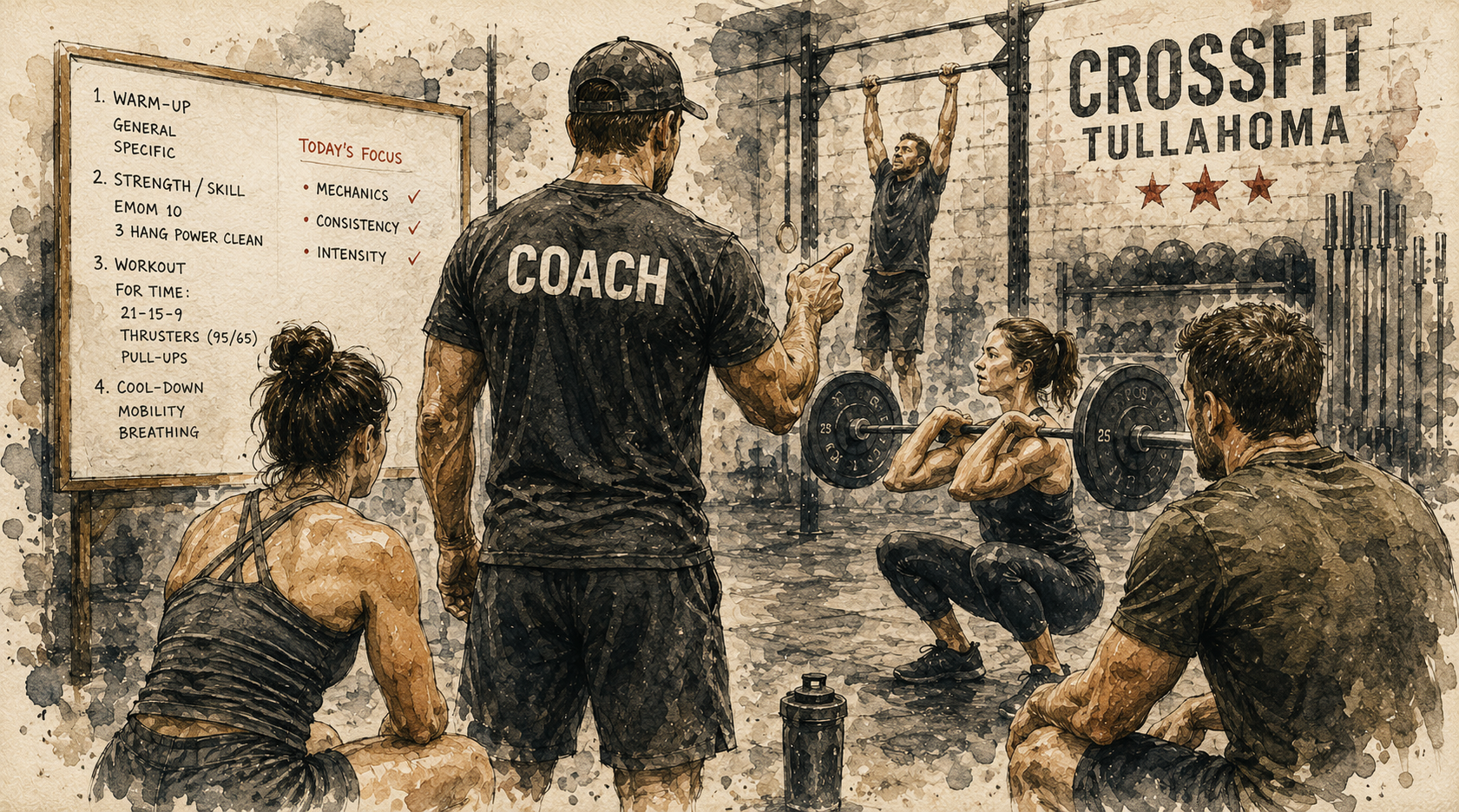
The coached environment matters especially at this stage. In your 40s, your body is less forgiving of sloppy movement than it was at 25. Movement faults that you could have gotten away with younger will start to catch up with you. Having a trained coach watching your mechanics, making adjustments in real time, and scaling your intensity appropriately isn't a luxury — it's protection. It's the thing that keeps you training for decades instead of stopping because of an avoidable injury.
The intensity is always scalable. This is one of the most misunderstood things about CrossFit from the outside. The intensity you see elite athletes bring to a workout is not the intensity required to get results. What's required is intensity that's appropriate for you — your fitness level, your training history, your body on that specific day. Forty-year-olds with desk jobs and three kids do not need to train like Games athletes. They need to train consistently, progressively, and intelligently. CrossFit accommodates all of that.
What People Over 40 Have That Younger Athletes Often Don't
Here's something I've observed coaching people across a wide range of ages: athletes in their 40s are frequently the most coachable people in the gym.
They're not there to perform for anyone. They're not chasing an identity or trying to prove something to their peers. They show up because they made a decision — usually a deliberate, hard-won one — that their health matters and they're going to do something about it. That motivation is grounded and durable in a way that's genuinely different from the motivation of a 22-year-old who joined because their friends did.
People over 40 tend to listen. They follow directions. They ask good questions. They understand that the warm-up matters, that the cool-down matters, that the coach is telling them to scale the weight for a reason. They've lived long enough to know the difference between shortcuts that work and shortcuts that cost you later.
They also tend to have a clarity about why they're training that younger athletes often lack. Not to look good for a reunion. Not to hit a number on a scale by a specific date. But to be present and capable for their family. To feel like themselves again. To age on their own terms rather than surrendering to what they assumed was inevitable.
That kind of why is powerful. It's the kind that keeps people consistent through busy weeks, through hard days, through the early weeks when everything is new and nothing feels natural yet.
What to Expect When You Start
I want to be honest with you about the first few weeks, because setting the right expectation matters.
It will feel new and awkward. The movements are technical, the environment is different from anything you've trained in before, and your body will respond to the new stimulus in ways that range from pleasantly surprising to genuinely humbling. That's normal and it's temporary.
What most people over 40 tell me — usually around the four to six week mark — is that they start noticing things outside the gym before they notice dramatic changes inside it. They're sleeping better. They have more energy during the day. They feel more capable in their daily life. The mental shift — the sense of doing something hard and discovering you can handle it — tends to arrive early and quietly, before the physical results that follow.
Progress at this stage is real, and it accumulates. The members I've watched come in as complete beginners in their 40s and 50s and train consistently for a year or two don't just look different — they move differently, carry themselves differently, and talk about their lives differently. The physical changes are the visible part of a much larger shift.
The Best Time to Start Is Still Now
Your body is not done adapting. Your window for building strength, improving your cardiovascular health, reclaiming your mobility, and changing the trajectory of how you age has not closed.
But it does require a decision. Not someday. Not when things slow down. Not when you feel more ready.
If you're in your 40s and you've been thinking about this — come talk to us. We'll meet you exactly where you are, and we'll build from there.
The best version of the next decade of your health starts with a single class.
Kodi Lovelace is a Certified CrossFit Level 3 Trainer and Coach at CrossFit Tullahoma, located in Tullahoma, TN. He's passionate about helping everyday people build lasting health through smart, varied, and sustainable fitness. If you have questions or want to learn more, reach out at crossfittullahoma.com and follow on Instagram @kodilovelace and @cftullahoma
Tags: CrossFit Tullahoma, CrossFit after 40, fitness over 40, starting CrossFit at 40, health and longevity, CrossFit for adults, functional fitness Tullahoma TN, getting fit in your 40s, sarcopenia, aging and fitness