Related

Your Kids Are Watching You
One of the quieter privileges of being a coach is getting to observe people over time.
Not just their fitness — their patterns. The things they say without realizing they've said them. The way they carry themselves on hard days versus easy ones. The moments of pride they don't perform for anyone, and the moments of frustration they probably wish no one saw.
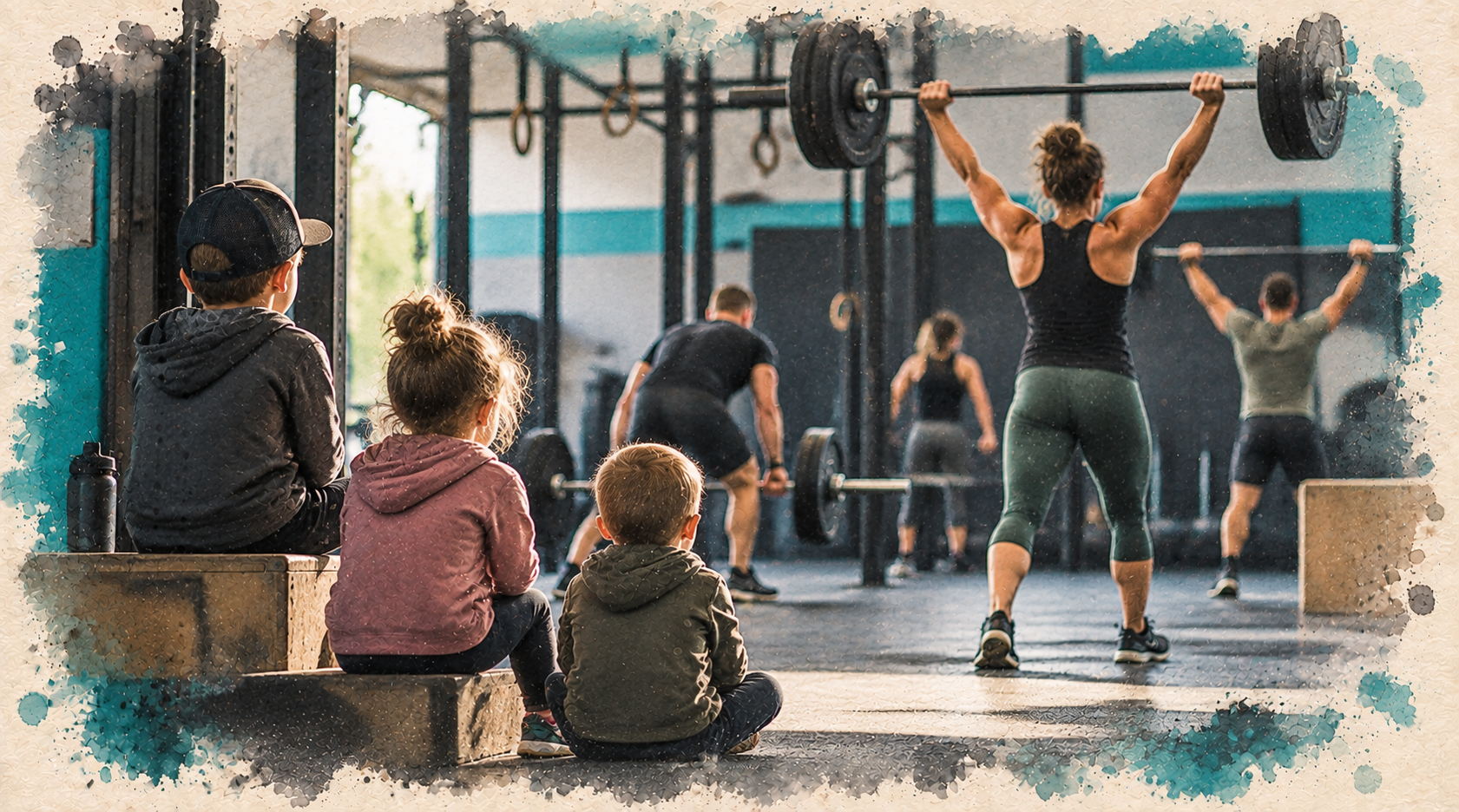
And then, sometimes, I get to watch those same people talk about what they do here with their kids. Or I see a child waiting near the door at the end of class, watching their parent finish a workout. And I'm reminded of something that I think about often — something I want to say carefully but directly to every parent who walks through this door:
Your children are building their entire understanding of what it means to be a healthy person by watching you. Not by listening to what you tell them. By watching what you do, what you say about yourself, and how you talk about your body, your food, and your effort — every single day.
That's not pressure. It's perspective. And I think it's worth sitting with.
The Lesson Nobody Teaches Out Loud
No parent sits their seven-year-old down and says: here's how to feel about your body or here's what food is for or here's what to do when something is hard. Those lessons don't get taught in conversations. They get absorbed — quietly, constantly, over years — from watching the most important people in a child's life navigate those exact things in real time.
From the gym floor, I see parents who show up consistently, who push themselves appropriately, who cheer for the person next to them, and who walk out of here looking like someone who just did something worth doing. Those parents may not realize it, but they are teaching their children — by pure example — that the body is something to care for, that hard work is worthwhile, and that showing up even when you don't feel like it is just what people who value themselves do.
That's an extraordinary gift. And most of them are giving it without thinking about it as a gift at all.
How Parents Talk About Their Bodies
Here's where the gentle challenge comes in — because this part matters more than the working out itself.
Children are listening when you don't think they are. They are listening at the dinner table, in the car on the way to school, in the bathroom mirror, and in every casual conversation you have with another adult about your body, your food, or your weight. And the language you use in those moments is being absorbed and filed away as truth.
When a parent says — even offhandedly — I look terrible or I'm so fat right now or I really let myself go — a child hears that. And they begin to develop a framework for how a person is supposed to evaluate their own body. They learn that bodies are judged. That the default relationship with the physical self is critical. That the mirror is something to dread rather than something neutral.
When a parent stands in front of food and says I shouldn't or that's so bad or I'm being terrible today — a child begins to understand food as something morally loaded. That eating has a guilt attached to it. That certain foods make you bad and certain foods make you good. That relationship with food, built in childhood, is one of the hardest things to untangle in adulthood — and it almost always traces back to an environment, not a decision.
None of this is meant to make you feel guilty for being human. We all say things we don't fully mean. But I'd invite you to notice how often those things get said — and what a child nearby might be making of them.
How Parents Talk About Exercise
There are two very different versions of the exercise story a parent can tell their child — and they have completely different long-term effects.
The first version sounds like this: I have to go to the gym. Or: I need to work off what I ate. Or: I hate this but I have to do it because I need to lose weight. Exercise as obligation. As punishment. As something you suffer through because you've failed somewhere else.
The second version sounds like this: I'm going to go do something that makes me feel really good. Or simply — a parent who comes home from a workout clearly better than when they left. More energetic, more present, more themselves. No explanation needed.
Children don't process the logic of why you exercise. They process how you feel about it. A parent who visibly dreads their training is teaching their child to dread it too. A parent who comes home from class looking like they just had an hour that belonged entirely to them — that's a child who grows up understanding that taking care of your body is something adults do because it matters, not something they endure.
What They Learn When They Watch You Do Something Hard
This might be the part I observe most and think about most as a coach.
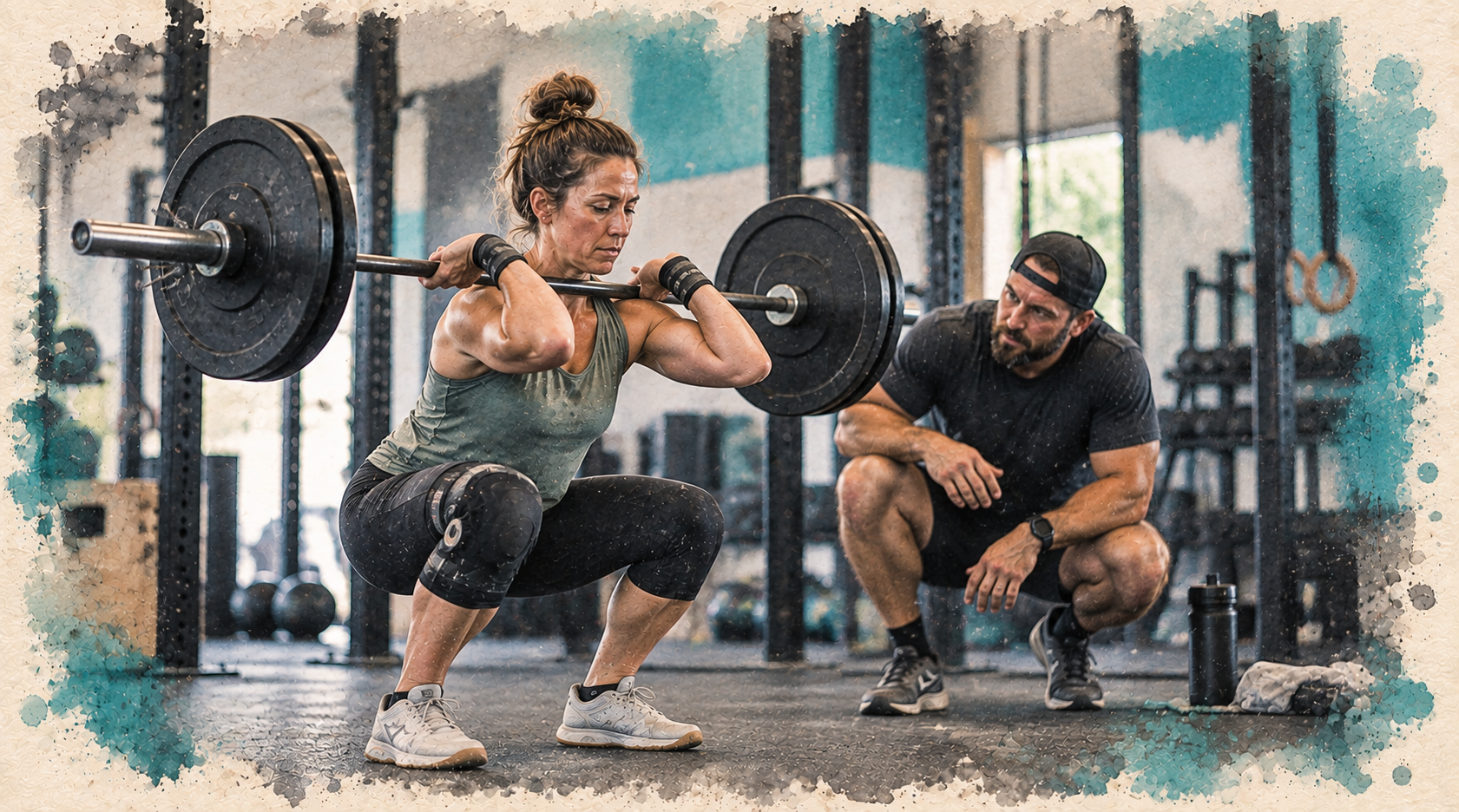
When a child watches a parent try something difficult — something that doesn't come easily, that requires repeated attempts, that might not go perfectly today — they are getting one of the rarest and most valuable lessons available to them:
That hard things are worth doing. That struggle is part of the process, not evidence of failure. That adults keep trying. That strength isn't something you either have or you don't — it's something you build, over time, by showing up and refusing to quit.
When a parent walks out of a workout they didn't finish the way they wanted to and says — that was hard, but I'll get it next time — a child is watching. And what they're seeing is a person who knows how to fail without being defeated by it. That is one of the most critical skills a human being can develop, and it cannot be taught in a classroom.
It can be modeled, though. Every single week, in a gym like this one.
The Gentle Challenge
I'm not asking you to be perfect. I'm not asking you to hide the hard days from your children or perform positivity that isn't real.
I'm asking you to be a little more intentional about the story you're telling them without words.
Notice how you talk about your body in front of them. Notice whether exercise is something you love or something you resent when they're listening. Notice what you say about food at the table. Notice whether they ever see you try something difficult and come back for it anyway.
And if you find that some of those things are more negative than you'd want a child to absorb — that's good information. That's a place to start. Not with a conversation, necessarily. With a change in what you do and how you talk about it.
Your kids are not waiting for a lecture about health and fitness. They're watching you live it. Or not live it. And they're taking notes the entire time.
What you build here — your strength, your consistency, your relationship with your own body — doesn't just belong to you. It belongs to the people at home who are watching you build it.
That's worth showing up for.
Kodi Lovelace is a Certified CrossFit Level 3 Trainer and Coach at CrossFit Tullahoma, located in Tullahoma, TN. He's passionate about helping everyday people build lasting health through smart, varied, and sustainable fitness. If you have questions or want to learn more, reach out at crossfittullahoma.com and follow on Instagram @kodilovelace and @cftullahoma
Tags: CrossFit Tullahoma, parents and fitness, kids watching parents exercise, body image children, modeling healthy habits, family fitness Tullahoma TN, CrossFit for parents, health and kids, raising healthy children, fitness role models