Related

You're Hurt. That Doesn't Always Mean You Have to Stop.
Let me say something that most people in the fitness world don't say clearly enough:
Everybody hurts something. All the time. A tight low back that shows up every Monday morning. A shoulder that complains during pressing. A knee that's been talking to you for three years. A stubbed toe, a stiff neck, a hip that clicks in a way it didn't used to. Pain — in some form, at some level — is just part of living in a body that you actually use.
The question isn't whether something hurts. The question is what you do about it.
And the answer, far more often than most people realize, is not to stop moving. It's to move smarter.
Pain and Injury Are Not the Same Thing
This distinction is the foundation of everything else in this article, and it comes directly from Dr. Kelly Starrett — a Doctor of Physical Therapy, co-founder of The Ready State (formerly MobilityWOD), and one of the most influential voices in human movement and pain management in the world. His books Becoming a Supple Leopard and Built to Move have become essential reading for coaches, physical therapists, and anyone serious about how the body works.
Starrett's position is clear: pain does not always mean you are injured. Pain is a signal — a message from your nervous system that something deserves attention. Injury is actual tissue damage. Those two things frequently occur together, but they don't always. And conflating them leads people to stop moving when movement is exactly what they need.
His philosophy — that every human being should be able to perform basic maintenance on themselves and move freely through life — starts with this premise: your body is more capable than the pain is telling you it is, and most non-traumatic pain is something a person can and should work through with appropriate movement, not around by avoiding the gym altogether.
The Difference Between Discomfort and Pain
Here's a practical threshold worth knowing.
Discomfort is the sensation of something being challenged, worked, fatigued, or unfamiliar. It's the burn in your lungs during a hard conditioning piece. It's the muscle fatigue in your legs at the bottom of a heavy squat. It's the tightness in your shoulders when you first press overhead after a week off. Discomfort is your body telling you it's working. That's what we're after.
Pain is different. Pain is sharp, sudden, or worsening. Pain is the kind of sensation that makes you instinctively stop — not because you're tired, but because something is wrong. Pain that increases during movement, that radiates in ways you don't recognize, or that follows an acute event — a fall, a pop, a sudden twist — is a signal that needs to be respected and, when in question, evaluated by a medical professional.
Between those two things is a wide middle ground that most people treat like pain when it's actually discomfort — and in doing so, they stop moving when movement would help them.
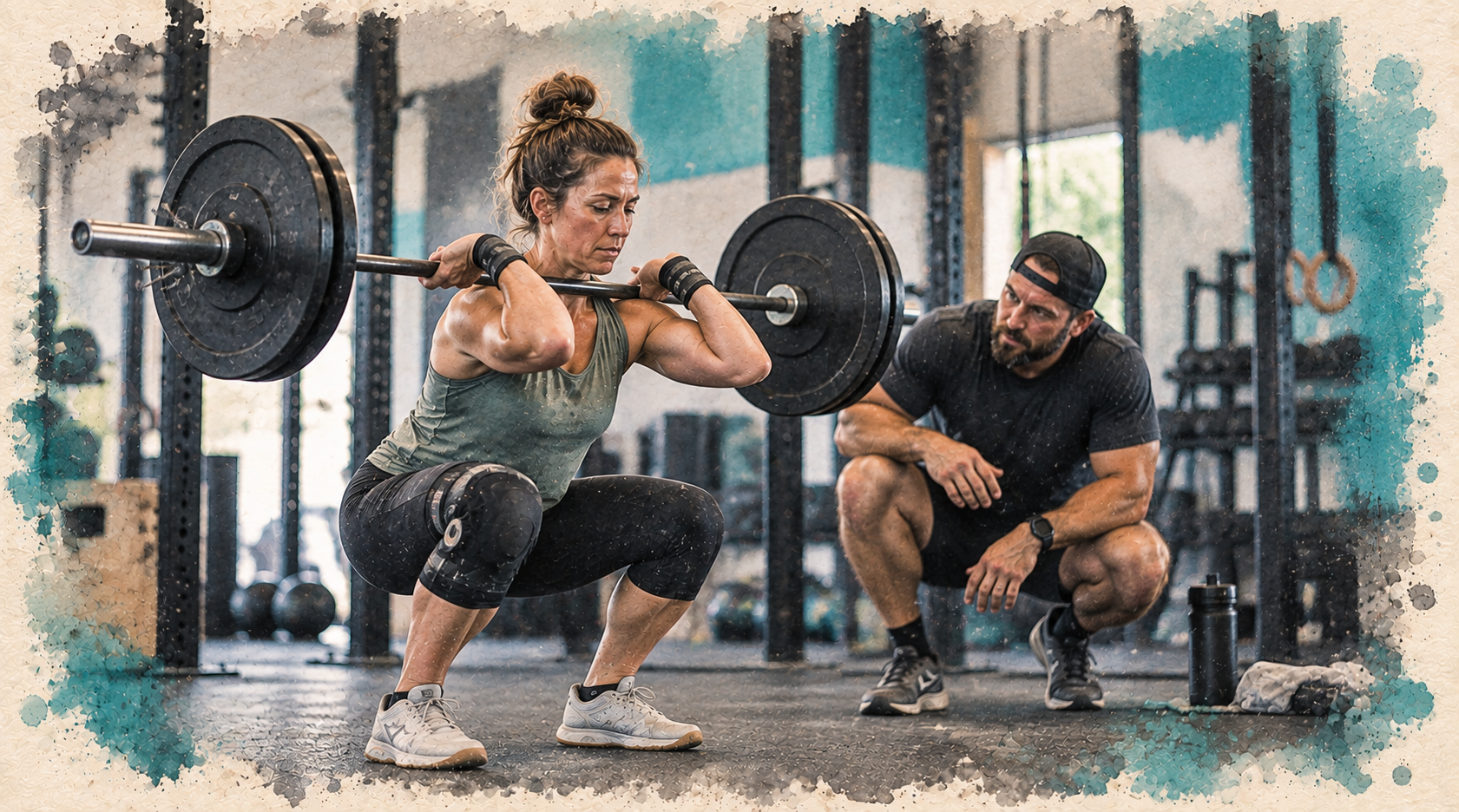
Learning to honestly distinguish between the two is one of the most valuable things you can develop as someone who trains consistently. Your coach can help you navigate that distinction in real time. It's exactly the kind of judgment that a trained eye in the room provides.
What Physical Therapy Actually Tells Us About Rest vs. Movement
Here's what the research says — and it probably contradicts what you've been told.
For years, the default response to pain and injury was rest. If something hurts, stop doing it. Ice it, elevate it, let it heal. And while that guidance makes sense for acute traumatic injury, it has been largely overturned by modern pain science when it comes to chronic pain, nagging injuries, and most of the everyday physical complaints that people experience.
Physical therapists now use a framework called graded exposure — the systematic reintroduction of movement in a safe, progressive, structured way. The research behind it is compelling. Systematic reviews of low back pain studies have found that graded activity programs were more effective at reducing disability than rest or pain medication alone. Movement, when dosed appropriately, doesn't just feel better — it actually reduces the nervous system's threat response, promotes tissue healing, and rebuilds the confidence and capacity to move without fear.
There's a modern pain science principle behind this: pain is an output of the brain produced when your nervous system concludes that tissue is in danger. It is not a direct, one-to-one readout of tissue damage. This is why people can have significant tissue damage with minimal pain, and significant pain with minimal tissue damage. The nervous system's threat assessment — which is deeply influenced by fear, stress, and movement avoidance — matters enormously. And movement is one of the most powerful tools available to recalibrate that assessment.
Simply put: doing less is often not the solution. Moving more — carefully, intentionally, within the appropriate range — usually is.
Training Around an Injury vs. Training Through One
This is where the practical coaching comes in.
Training through an injury means ignoring the signal, loading the compromised tissue, and pushing through pain because you don't want to miss a workout. This is where ego lives, and it's where avoidable setbacks happen. Training through legitimate pain — the sharp, worsening, acute kind — turns a manageable problem into a real one. Don't do this.
Training around an injury means keeping your body moving, preserving the training stimulus, and finding what can be worked while the compromised area recovers. This is intelligent, and it's almost always possible.
Hurt your shoulder? Your legs, your core, and your cardiovascular system are fine. We can build a workout around that. Dealing with a knee issue? Your upper body pressing and pulling, your rowing, your core work — all of it is available. Got a nagging low back? We modify the loading, adjust your positions, and keep you moving in ways that don't provoke the area while often actively helping it.
The body doesn't need to be 100% for you to get a meaningful training session. It just needs for you to be honest about what's going on and willing to communicate with your coach so the right decisions get made.
Habituation: Why Moving Through Discomfort Actually Reduces It
There's a principle in pain science called habituation — the process by which repeated, non-threatening exposure to a stimulus reduces the nervous system's response to it over time.
In plain language: when you avoid a movement because it's uncomfortable, your nervous system learns to treat that movement as a threat. The avoidance makes it worse. When you gradually, repeatedly expose yourself to that movement in a safe and controlled way — inside an appropriate range, at an appropriate load, with good coaching — your nervous system begins to recalibrate. The threat response decreases. The discomfort decreases. Function returns.
This is one of the reasons that keeping people moving, even through discomfort, is so central to modern physical therapy — and why showing up to train with a modification is almost always better than staying home.
When You're in a Boot, a Brace, or a Cast
Here's something worth saying directly to anyone who's dealing with a more significant injury: you are not broken everywhere.
A foot in a boot means your upper body, your core, your cardiovascular system, and most of your functional capacity are completely available. A wrist in a brace means your legs, your pulling movements, and your conditioning work are untouched. Even in the most limiting injury scenarios, there is almost always something meaningful to be done.
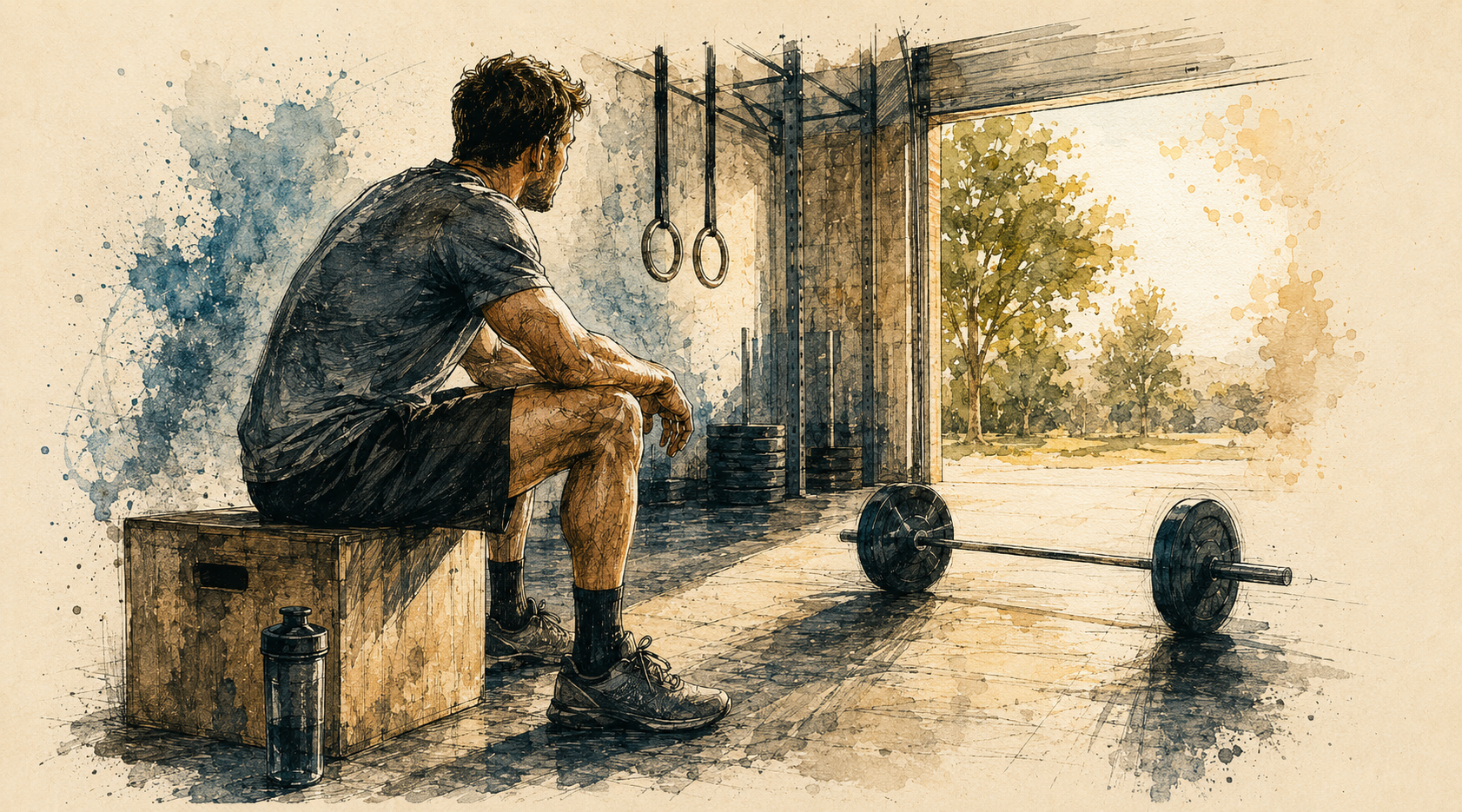
More than that — showing up matters. The habit of showing up, even in a limited capacity, is what keeps you connected to the community, to the routine, and to the momentum of your health journey. The people who disappear completely when they get hurt are the ones who have the hardest time coming back. The ones who show up even when they can't do everything are the ones who come back strong.
Come in. Tell your coach what's going on. Let us figure it out together.
When You Actually Do Need a Professional
I want to be clear: there are times when the right move is to see a doctor or physical therapist, and a coach should never be a substitute for that.
If you experience sudden, sharp pain following an acute event — a fall, a collision, a sudden pop or snap — get evaluated. If pain is worsening with movement rather than staying the same or improving. If you have numbness, tingling, or radiating pain down a limb. If something doesn't resolve or improve over a reasonable period of time. These are signals that deserve professional attention, not just modification.
The goal of this article is not to tell you to ignore pain. It's to tell you that most of the everyday discomfort people experience is not a reason to stop training — and that the instinct to do nothing is usually the wrong one.
Move more. Move smarter. Communicate with your coach. And when something needs professional eyes on it, get those professional eyes.
Pain is information. It deserves to be heard, understood, and responded to wisely. What it rarely deserves is a full stop.
Your body wants to move. Most of the time, even when something hurts, the answer is more movement — not less. Just smarter movement, with the right guidance, in the right direction.
That's what we're here for.
Kodi Lovelace is a Certified CrossFit Level 3 Trainer and Coach at CrossFit Tullahoma, located in Tullahoma, TN. He's passionate about helping everyday people build lasting health through smart, varied, and sustainable fitness. If you have questions or want to learn more, reach out at crossfittullahoma.com and follow on Instagram @kodilovelace and @cftullahoma
Tags: CrossFit Tullahoma, training with injury, CrossFit injury modification, pain and fitness, Kelly Starrett Ready State, training around injury, CrossFit scaling, pain management fitness, mobility Tullahoma TN, functional fitness injury