Related

What You're Actually Paying For When You Walk Into A CrossFit Class
Let me address something that comes up from time to time — usually from someone who's used to a traditional gym membership, where you pay a monthly fee, walk in whenever you want, do whatever you feel like doing, and leave.
CrossFit is structured differently. There's a coach. There's a class. There's a plan for the hour that you didn't write and aren't being asked to change. And the price point is higher than a standard gym membership.
A fair question follows: What exactly am I paying for?
It's a great question, and the honest answer goes a lot deeper than most people expect.
The Hour Is Designed. All of It.
Before you ever walk through the door, someone has already done significant work on your behalf.
Every CrossFit class follows a deliberate structure — not because gyms like routines, but because the science of how the body prepares for and recovers from training is well established, and ignoring it produces worse results and higher injury risk.
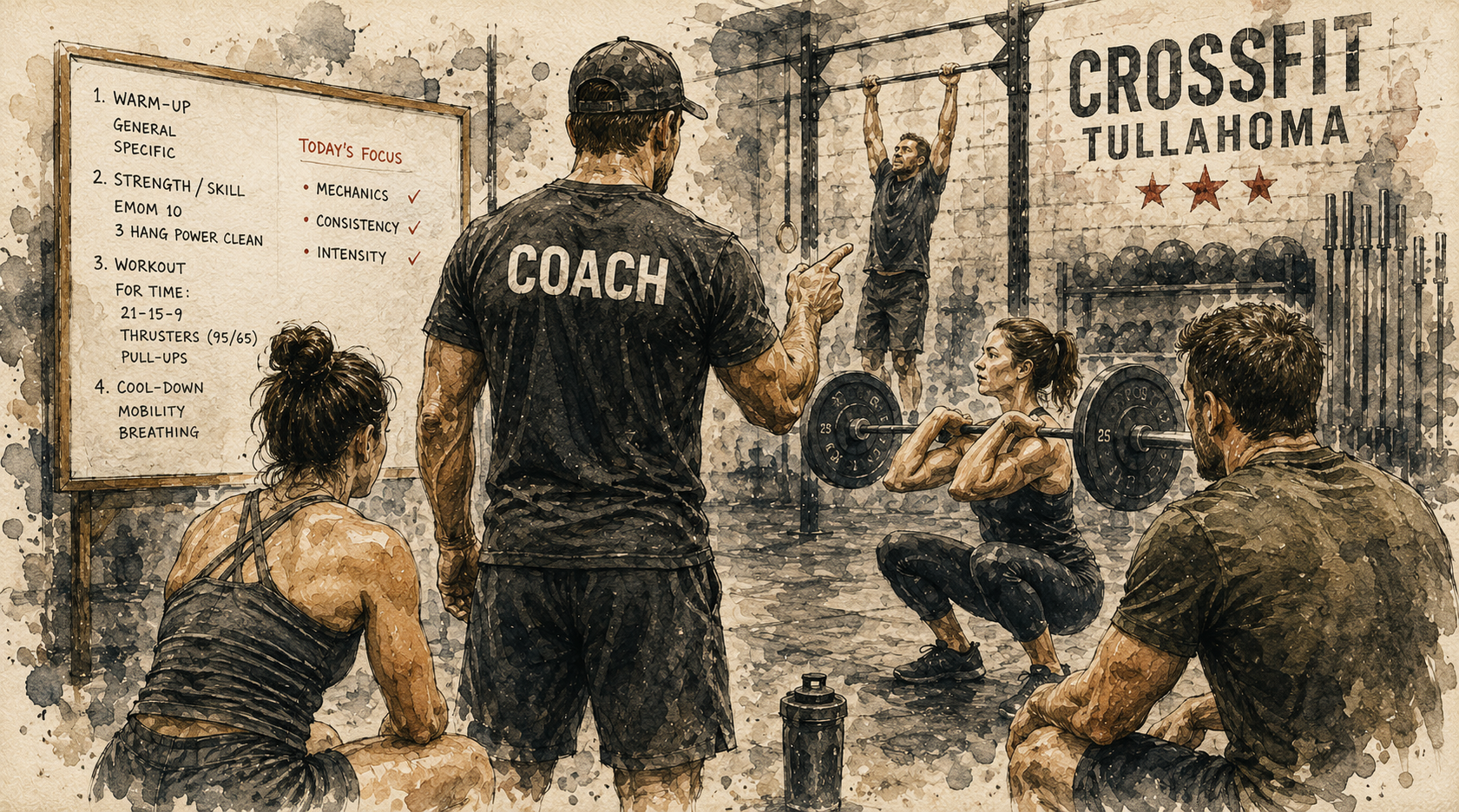
No two classes look exactly alike. The movements change, the workout changes, the energy in the room changes. But underneath all of that variety, the same care and the same structure get applied every single time:
The whiteboard brief is where your coach lays out the plan for the hour — what you're doing, why you're doing it, and what the workout is designed to accomplish. This sounds simple, but it's the moment that sets your intention for the next 60 minutes. You get started knowing the purpose, not just the movements.
The general warm-up raises your heart rate and core temperature and gets blood moving through the muscles broadly. This is the foundation — waking the whole body up before anything specific happens.
The specific warm-up narrows the focus to exactly what the day's training requires. If the workout involves heavy pulling, this is where the posterior chain, the lats, and the grip get prepared. If there's overhead work, this is where the shoulders and thoracic spine open up. A specific warm-up is built around the actual demands of the hour, not a generic routine run on repeat.
Skill or strength work often gets inserted here — between the specific warm-up and the workout — and when it does, it's there for a reason. This is where new movement patterns and skills get rehearsed, where technique gets refined under low fatigue, and where strength gets built progressively over time. Not every class includes this piece, but when it's there, it's because your coaches identified something worth building before the higher-intensity work begins.
The workout comes after all of that — after you're warm, after you've rehearsed, after your coach has told you what the intended stimulus is. And that last part matters more than people realize. Knowing whether a workout is meant to be heavy and slow or light and fast completely changes how you should approach it. The stimulus is the point. The score on the board is just a record of whether you hit it.
The cool-down is the piece most people would skip if left on their own — and it's the piece that quietly affects how you feel tomorrow, next week, and years down the road. Bringing your heart rate down with intention, addressing the tissue that just worked, and giving your body a clear signal that it's time to shift into recovery — that's not filler. That's part of the program.
Every piece of that structure is built thoughtfully, every single day, by a coach who understands that an hour of training is not just an hour of moving haphazardly.
The Trained Eye Changes Everything
Here's something worth sitting with: you cannot see yourself move.
You can feel yourself move. You can have a sense of whether something feels right. But the movement fault that's been quietly loading your lower back for six months, the knee that's been caving in on every squat rep, the shoulder that's compensating because of a mobility restriction you don't know you have — you cannot see those things. Someone else can.
That's what a CrossFit coach is doing during every class. They're watching. Not casually — actively. Good coaches train themselves to know exactly which part of a movement to watch, what correct mechanics actually look like in motion, and how to tell the difference between a fault that needs fixing right now for safety and one that should be addressed gradually through better instruction over time.
The best coaches learn to prioritize the dynamic parts of a movement — the parts happening in motion, which are usually where power is generated — rather than only catching the obvious stuff at the very start or end of a rep. That distinction matters, because the faults happening in the middle of a movement are frequently the ones quietly causing both reduced performance and elevated injury risk, and they're exactly the kind of thing an untrained eye would never catch.
When a coach pulls you aside to adjust your squat depth, cue your breathing pattern on a heavy deadlift, or tell you to scale a movement down, they're not being controlling. They're doing exactly what they're trained to do — protect the long-term integrity of your movement while helping you extract the most out of every training session.
Why Your Coach Won't Just Let You Go Hard
This is probably the most important thing I can explain in this entire article, because it's the thing that gets misunderstood the most.
Good coaches are trained to prioritize three things, in a specific order, every single time: mechanics first, then consistency, and only then intensity.
Mechanics first means the way you move matters more than how much weight is on the bar or how fast you're moving. Before intensity is ever added to a movement, the pattern has to be sound. A clean, repeatable, safe movement pattern is the foundation everything else gets built on. Skip this step, and you're not getting fitter — you're rehearsing a flaw and getting better at doing it wrong, faster.
Consistency second means once the mechanics are solid, the next priority is doing that movement correctly, over and over, across weeks and months. This is where a pattern becomes durable — where your body stops having to think about it and starts just doing it. Consistency is what turns a skill you learned into a skill you own.
Intensity last means only once mechanics are sound and consistency has been built do we start asking you to push — heavier weight, faster pace, less rest. And even then, intensity isn't a fixed number. It's relative to you, on that specific day. What counts as intense for you on a day when you slept eight hours, ate well, and feel great is different from what counts as intense on a day when you're running on four hours of sleep, stressed about work, and your body is telling you something different. A good coach reads that. They know the difference between pushing you appropriately and pushing you into a setback.
This is exactly why having a coach in the room matters so much. You, on your own, are not in a great position to objectively judge your own mechanics, your own readiness for more consistency, or your own appropriate intensity on a given day. You're inside your own head and your own body — which is exactly the wrong vantage point for that kind of assessment. A coach has the outside perspective, the trained eye, and the experience to make that call for you, in real time, every single class.
That's the whole reason the structure exists. That's the whole reason the coach is bouncing around in class instead of just standing there hitting start on a timer, turning up the music, and sipping their energy drink. It's also the single biggest reason people who train inside a coached class setting get better results, stay healthier, and stick with their training longer than people training the exact same movements completely on their own.
What It Actually Takes To Stand On That Floor
The fitness industry has a low barrier to entry. Hell, a social media following is enough to put some people in front of clients. CrossFit coaching doesn't work that way, and I think it's worth understanding why.
Becoming a CrossFit coach starts with a real, in-person education — not a quick online quiz. From there, coaches who are serious about the craft keep going: more coursework, more hours in the gym actually coaching real people, more time spent being evaluated and corrected by other experienced coaches. Eventually, for those who want to demonstrate real mastery, there's a rigorous certification exam that has nothing to do with attendance and everything to do with what you actually know — you either pass it or you don't, and there's no partial credit for showing up.
I hold the CF-L3 certification. I'm not telling you that to put credentials on a pedestal for their own sake. I'm telling you because I want you to understand that when a coach is standing in front of your class, the education and experience behind that position is real, it's ongoing, and it's held to a meaningful standard with hundreds if not thousands of coaching hours behind it.
The coaches who take that seriously — who keep studying, who keep getting evaluated like we do here at CrossFit Tullahoma, who keep sharpening their eye — are the coaches whose people get better faster and stay healthier longer. That investment in coaching education is happening behind the scenes every single time you walk into class, whether you see it or not.
Why The Class Structure Isn't A Limitation
I understand why someone might walk in and want to do their own thing. Maybe you have a movement you love. Maybe you had a program you were following somewhere else. Maybe you just don't feel like doing what's on the board today.
Here's my honest perspective on that: the structure isn't a rule for the sake of rules. It's there because random structure produces random results. Thoughtful structure produces measurable improvement over time.
When you follow the class — when you trust the warm-up even if it feels slow, when you do the skill work even if you'd rather just get to the workout, when you finish with the cool-down instead of heading for the door — you're investing in an outcome that's bigger than today's session. You're building a body that moves well, recovers well, and keeps showing up.
The coach's job is to see what you can't see, to structure what you might not structure for yourself, and to push you appropriately while protecting you from the kind of mistakes that end training careers. That's a real service — and it's worth paying for.
CrossFit Tullahoma exists because we believe the coached group class model — done right — is the most effective training environment available to everyday people who want to be healthy, capable, and strong for the rest of their lives. Every class we run is built around that belief.
Come experience it for yourself.
Kodi Lovelace is a Certified CrossFit Level 3 Trainer and Coach at CrossFit Tullahoma, located in Tullahoma, TN. He's passionate about helping everyday people build lasting health through smart, varied, and sustainable fitness. If you have questions or want to learn more, reach out at crossfittullahoma.com and follow on Instagram @kodilovelace and @cftullahoma
Tags: CrossFit Tullahoma, CrossFit coaching, what is a CrossFit coach, CF-L3, CrossFit class structure, coached fitness, CrossFit certification, fitness Tullahoma TN, personal training vs CrossFit, group fitness coaching