Related

What Eating Real Food Actually Means In 2026 (And Why The Answer Is Simpler Than The Internet Wants You To Think)
If you've tried to figure out what to eat in the last five years, you've probably felt like you needed a law degree to sort through it all.
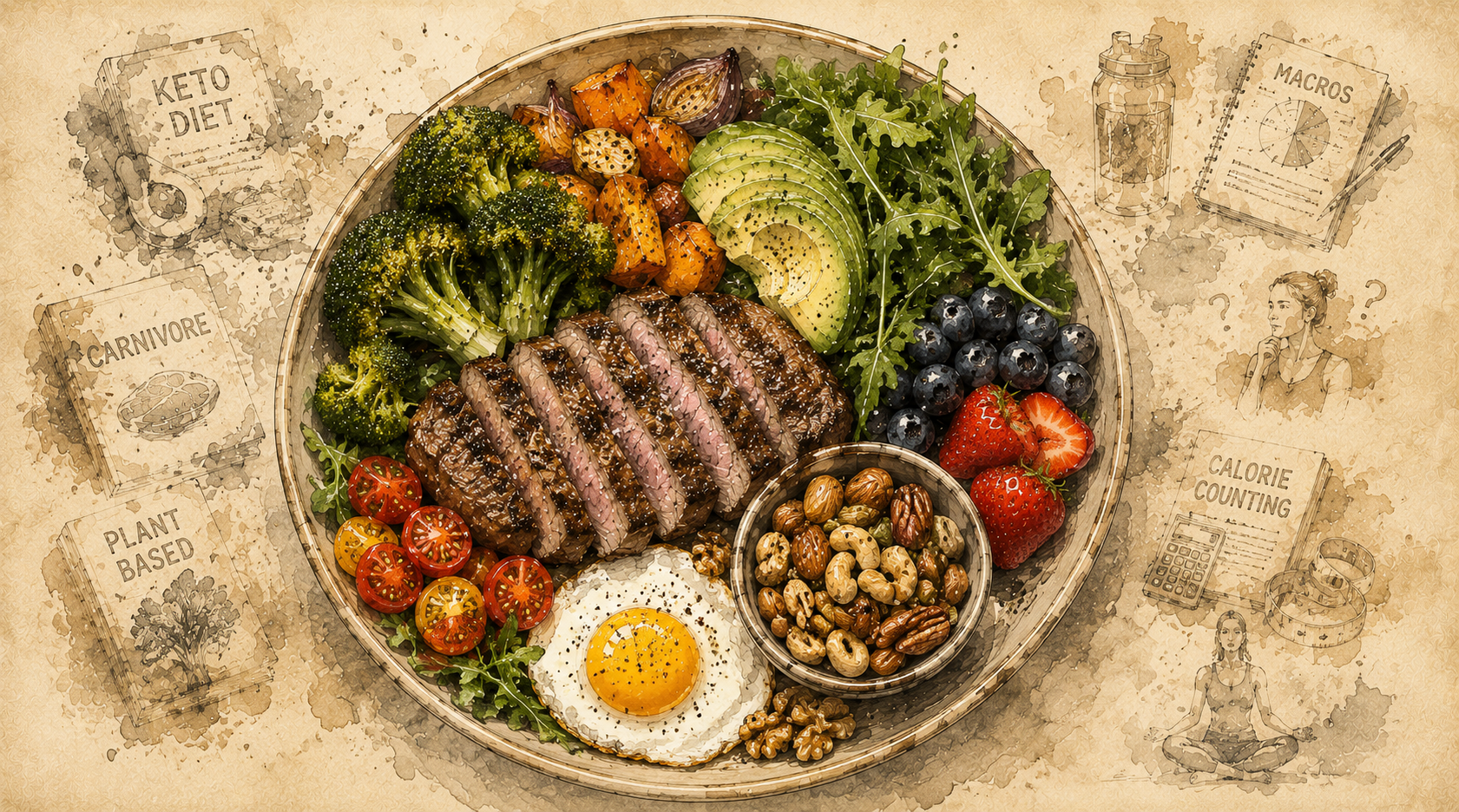
Keto. Carnivore. Vegan. Plant-based. Paleo. Whole30. Intuitive eating. Macro counting. Calorie cycling. Protein-sparing modified fasting. Each one comes with a passionate community, a stack of testimonials, a bestselling book, and a compelling argument for why this particular approach is the one that finally makes sense.
And most people end up doing one of two things: bouncing between approaches every few months chasing results, or throwing their hands up and eating whatever they want because the whole conversation feels exhausting.
Here's what I want to offer instead — a framework that's been around since 2002, fits on half a page, doesn't require an app, doesn't eliminate entire food groups, and has been tested on thousands of people across every fitness level imaginable.
Start Here
CrossFit founder Greg Glassman wrote what's known as Fitness in 100 Words — a short, plain-language prescription for what fitness actually looks like. The nutrition portion reads like this:
"Eat meat and vegetables, nuts and seeds, some fruit, little starch and no sugar. Keep intake to levels that support exercise but not body fat."
That's it. Twenty-seven words. And before you dismiss it for being too simple — let's talk about what it actually contains, because it's more sophisticated than it looks.
What Those 27 Words Are Actually Saying
Meat and vegetables — Protein from real animal sources. Micronutrients, fiber, and phytonutrients from a wide variety of vegetables. This combination builds and repairs muscle, supports gut health, manages inflammation, and provides the vitamins and minerals your body needs to function and recover from training.
Nuts and seeds — Healthy fats. Omega-3s, vitamin E, magnesium. These support hormone production, joint health, brain function, and sustained energy. They're also calorie-dense, which is why the prescription doesn't say eat as many as you want — it says eat them.
Some fruit — Not unlimited. Some. Fruit provides natural sugars, antioxidants, and fiber, and it has a place in a performance-focused diet. The qualifier "some" is doing real work in that sentence.
Little starch, no sugar — This is where it gets direct. Starchy carbohydrates like rice, potatoes, and bread aren't forbidden — they're limited. And sugar isn't limited; it's eliminated. Not because carbohydrates are the enemy, but because the dose matters enormously and most people's default dose is wildly out of range.
Keep intake to levels that support exercise but not body fat — This is built-in portion awareness without a single calorie counted. It's asking you to eat enough to train hard and recover well, and not so much that you're storing the excess. It's simple in principle and requires some honest self-awareness in practice — which is actually the point.
Here's What's Worth Keeping From All That Noise
The popular nutrition approaches of the last decade didn't come from nowhere. Each one was reaching toward something real. The problem isn't that they're wrong — it's that they overcomplicate what's already covered by a simpler framework.
Keto and low-carb made an important point: most people are eating far too much sugar and refined starch, and reducing those things produces real, measurable results in weight, energy, and metabolic health. That's true. Fitness in 100 Words already prescribes little starch and no sugar — it just doesn't require you to count net carbs or carry a glucose monitor to get there.
Carnivore is an extreme elimination diet, but the core instinct behind it is sound: prioritize animal protein, eliminate processed food, and reduce inflammatory inputs. Most people who thrive on carnivore are doing so because they finally stopped eating garbage — not because beef alone is magic. The Fitness in 100 Words framework captures the protein priority and the whole food emphasis without requiring you to give up vegetables, fruit, and the micronutrients that come with them.
Vegan and plant-based eating got people paying attention to vegetables in a way that most Western diets desperately needed. The focus on whole plants, fiber, and reducing processed meat is legitimate. Where plant-based diets often fall short is in protein quality and quantity — it's genuinely harder to hit the protein targets that support muscle building and recovery without animal sources. The Fitness in 100 Words prescription leads with meat for exactly this reason, while still building vegetables into the foundation.
Macro counting gave people something valuable: awareness. Understanding that food is composed of protein, carbohydrates, and fat — and that the ratio matters — is genuinely useful knowledge. The limitation is that macro tracking can reduce food to numbers and quietly justify eating processed food as long as it hits your targets. Thirty grams of protein from grilled chicken and thirty grams of protein from a processed protein bar are not the same thing, and a macro tracker won't tell you that. The Fitness in 100 Words framework bakes food quality into the foundation so the numbers take care of themselves.
Why This Pairs So Well With CrossFit Specifically
CrossFit training places real demands on your body. The varied movements, the intensity, the combination of strength and conditioning work — all of it requires fuel, and the quality of that fuel directly affects your performance and your recovery.
When you're eating meat, vegetables, nuts, seeds, and some fruit as your foundation, a few things happen that matter specifically for CrossFit:
Your protein intake supports muscle repair and growth. Your carbohydrate intake — from vegetables and some fruit — provides enough glycogen for high-intensity work without the blood sugar spikes and crashes that processed carbs create. Your fat intake supports hormone production, including the hormones that govern recovery and body composition. And your overall food quality reduces systemic inflammation, which means you recover faster between sessions and spend less time feeling beat up.
The inverse is also true. Trying to do CrossFit seriously while eating a high-sugar, high-processed-food diet is like putting low-grade fuel in a high-performance engine. The engine can run. It just won't run the way it's capable of running, and the wear and tear adds up faster than it should.
The Practical Version of This
You don't need to overhaul your entire life overnight. Start with the question Fitness in 100 Words is really asking: is what's on your plate real food?
Does it have a mother or does it grow from the ground? Then it's probably in. Did it come out of a factory, a bag, or a drive-through window? Then it's probably the problem.
Build your plate around a protein source, load it with vegetables, add some healthy fat, and let fruit and minimal starch fill in around the edges. Eat enough to train and recover well. Don't eat so much that you're storing the excess.
That's not a diet. That's just eating like a healthy human being — which turns out to be the most radical nutrition advice available in 2026.
The noise isn't going away. There will be a new approach next year and the year after that. But the fundamentals don't change — they never have. Real food, eaten in reasonable amounts, in support of hard training. That's the whole thing.
If you want to talk through what this looks like for your specific goals, come find us. That conversation is one of our favorite ones to have.
Kodi Lovelace is a Coach at CrossFit Tullahoma, located in Tullahoma, TN. He's passionate about helping everyday people build lasting health through smart, varied, and sustainable fitness. If you have questions or want to learn more, reach out at crossfittullahoma.com and follow on Instagram @kodilovelace and @cftullahoma
Tags: CrossFit Tullahoma, real food nutrition, Fitness in 100 Words, CrossFit nutrition, keto vs paleo vs vegan, what to eat for CrossFit, nutrition Tullahoma TN, healthy eating Tullahoma, nutrition and fitness