Related

Train With Your Cycle, Not Against It: A Woman's Guide To Performance, Hormones, And Nutrition
If you've ever had a workout that felt absolutely effortless — like your body was firing on all cylinders — and then had a workout three weeks later that felt like moving through wet concrete…you weren't imagining it. You weren't weak. You weren't failing.
Your hormones were doing exactly what they're supposed to do.
Most fitness programming is built on a 24-hour hormonal cycle — because that's how the male body works. Women operate on a 28-day cycle, and the hormonal shifts across that cycle are dramatic enough to meaningfully affect your energy, your strength, your recovery, your mood, your cravings, and your ability to perform. Ignoring that isn't discipline. It's working against your own biology.
Here's the good news: once you understand what's happening inside your body across each phase, you can start working with it. You can train harder when your body is primed for it, recover smarter when it needs that, and fuel yourself in ways that support performance and health throughout the entire month — not just the days when you happen to feel good.
Let's break it down.
The Four Phases And What They Actually Mean
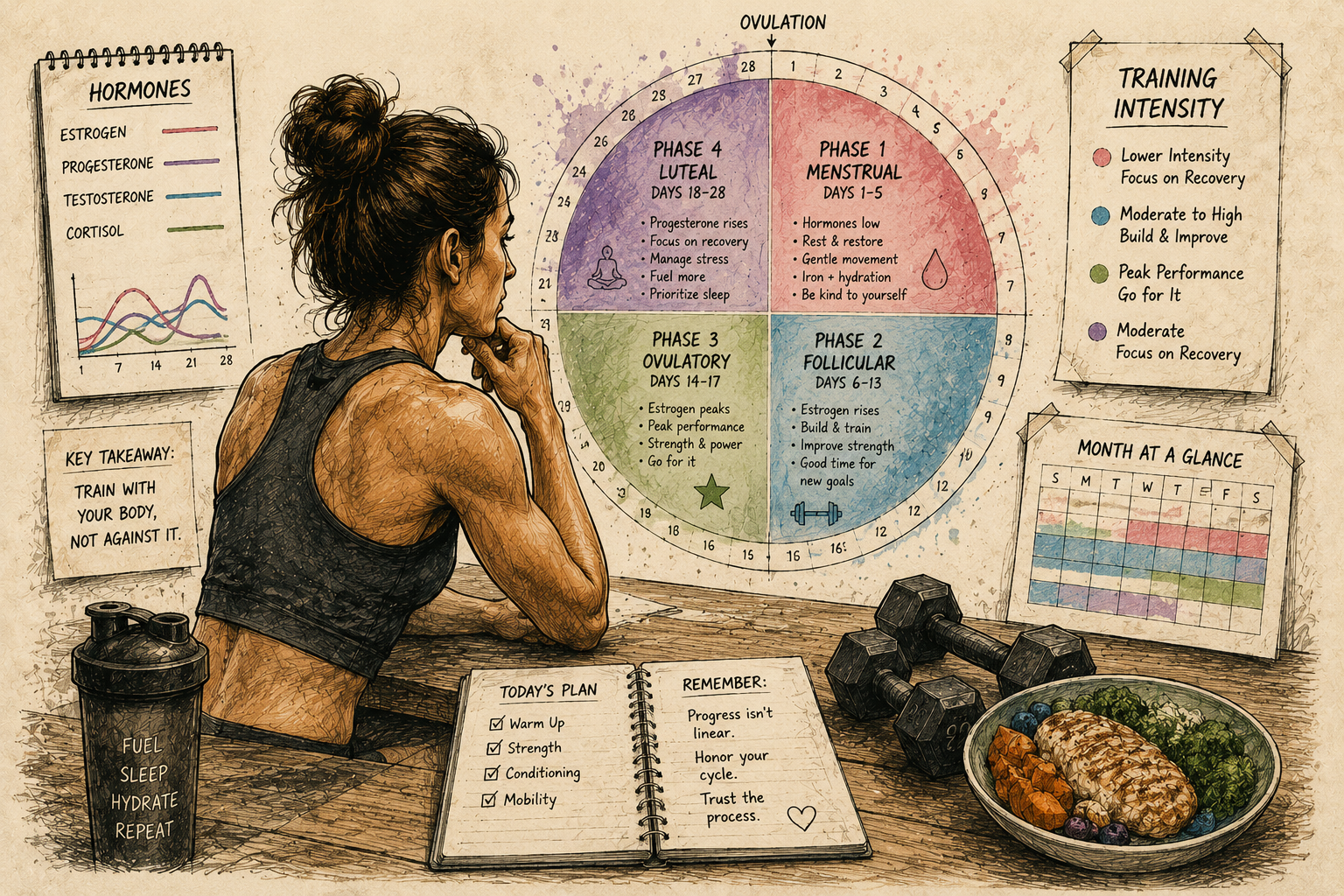
Phase 1 — Menstrual Phase (Days 1–5)
Estrogen and progesterone are at their lowest.
This is day one of your period through the end of bleeding. Both estrogen and progesterone drop sharply, which is what triggers menstruation. Inflammation is higher, energy is lower, and your body is doing real work internally even if you're not doing much externally.
Training: This is not the time to PR your back squat. Light to moderate movement — steady-state cardio, controlled barbell work at lower percentages, or even just a focused mobility session — is going to serve you much better than grinding through a high-intensity workout on an empty tank. That doesn't mean you have to skip the gym. It means you listen to what your body is telling you and scale accordingly without guilt.
Nutrition: Iron is being lost through bleeding, so lean red meat, spinach, and leafy greens become especially valuable this week. Anti-inflammatory foods — fatty fish like salmon, berries, and nuts — can help with cramping and general discomfort. Hydration is critical. And within the framework of Fitness in 100 Words — meat, vegetables, nuts, seeds, some fruit — you're already building from the right foundation. Focus on the quality here and don't undereat. Your body needs fuel even when it's not being pushed hard.
Phase 2 — Follicular Phase (Days 6–13)
Estrogen begins rising steadily.
This is where you'll start feeling like yourself again — and then some. As estrogen climbs, so does your energy, your mood, your pain tolerance, and your ability to recover between sessions. Neuromuscular coordination improves. Your body is literally more capable of learning new movement patterns and expressing strength during this window.
Training: This is your green light phase. Increase intensity. Add load to the barbell. Attack skill work — this is a great time to work on a pull-up progression, dial in your snatch, or push your pacing on conditioning pieces. Your body is primed to adapt, and the work you put in here will stick. If there's ever a week to challenge yourself, this is it.
Nutrition: Estrogen is metabolized in the liver and cleared partly through the gut, and cruciferous vegetables — broccoli, cauliflower, Brussels sprouts, kale — actively support that clearance process. This isn't just wellness-speak; it's functional nutrition. Lean proteins remain your anchor, and you may find your appetite is naturally a little lower during this phase, which is normal. Don't undereat, but don't force it either. Let quality drive the plate.
Phase 3 — Ovulatory Phase (Days 14–17)
Estrogen peaks. Luteinizing hormone (LH) surges.
This is your performance peak. Estrogen hits its highest point, testosterone briefly spikes alongside it, and together they create the ideal hormonal environment for strength, power, and competitive output. This four-day window is as good as it gets physiologically.
Training: Go for it. This is the time to test a max effort lift, push your intensity in a benchmark workout, or compete if that's your thing. Your body is as ready as it's going to be this cycle. Take advantage of it.
One note worth knowing: ligament laxity — the looseness in your joints — also peaks around ovulation due to the estrogen spike. This doesn't mean you're going to get hurt, but it does mean proper warm-up, solid movement mechanics, and not being reckless with load matter even more during this window. Move well, then move heavy.
Nutrition: Keep doing what's working. Fiber-rich vegetables help your body continue clearing estrogen efficiently. Protein supports the muscle-building stimulus you're creating with your training. Hydration supports everything. This isn't a complicated phase nutritionally — just don't abandon good habits because you're feeling great.
Phase 4 — Luteal Phase (Days 18–28)
Progesterone rises. Estrogen drops. Body temperature increases slightly.
This is the longest phase and the most misunderstood one. Progesterone takes over, and with it comes a cascade of changes: core body temperature rises slightly (which affects perceived exertion — things feel harder even when you're working at the same intensity), resting metabolic rate increases by roughly 100–300 calories per day, insulin sensitivity decreases, and serotonin levels drop — which is largely responsible for the mood shifts and cravings many women experience in the week before their period.
Training: Early in the luteal phase (Days 18–22 or so), you can still train at moderate-to-high intensity. By the back half (Days 23–28), dialing back makes physiological sense. Longer rest periods, more emphasis on steady aerobic work, less chasing of PRs. This isn't weakness — it's periodization. Elite female athletes build their training cycles around exactly this kind of phase management.
Nutrition: This is the phase where nutrition does the most work — or the most damage. As estrogen falls during this phase, the brain's ability to produce and use serotonin efficiently can be affected — and that's largely where the mood shifts and cravings come from. They're not a character flaw. They're a neurochemical response.
Here's how to work with it rather than against it: complex carbohydrates support serotonin production — just without the crash that sugar brings. Sweet potato, rice, and squash are your allies here. Within the Fitness in 100 Words framework of "little starch," this is the phase where that "little" can and should lean slightly higher. It's strategic, not a slip. Magnesium-rich foods — dark leafy greens, pumpkin seeds, dark chocolate in reasonable amounts — help with PMS symptoms and sleep quality. Keeping protein intake high during this phase is smart — your metabolic rate is elevated, your body is working harder, and protein supports recovery and muscle retention when demands are up. And because your body temperature is higher, sweat loss increases — so water intake needs to match that.
The Big Practical Takeaway
You don't have to overhaul your entire life to apply this. Start simple:
Track your cycle. Apps like Clue, Flo, or even just a paper calendar work fine. Once you know where you are in your cycle, you can start connecting your training experience to your hormonal reality instead of being confused by it.
Stop fighting the hard days. When your body is in a low-energy phase and you modify the workout or take it easier, that's not failure. That's intelligent training.
Protect your nutrition anchor. Whatever the phase, Fitness in 100 Words gives you the foundation: meat, vegetables, nuts, seeds, some fruit. Adjust the details around that based on where you are in your cycle. The anchor doesn't move.
Lean into the high-output phases. When estrogen is peaking and you're feeling strong, don't talk yourself out of pushing. That's your body telling you it's ready
The women I've coached who start training with their cycle — rather than just muscling through every phase the same way — consistently feel better, perform better, and stay more consistent over time. Not because they're working harder. Because they're working smarter.
Your hormones aren't your obstacle. They're information. Start listening to them.
Kodi Lovelace is a Coach at CrossFit Tullahoma, located in Tullahoma, TN. He's passionate about helping everyday people build lasting health through smart, varied, and sustainable fitness. If you have questions or want to learn more, reach out at crossfittullahoma.com and follow on Instagram @kodilovelace and @cftullahoma
Tags: CrossFit Tullahoma, women's fitness, hormones and exercise, training by cycle phase, CrossFit for women, women's nutrition, menstrual cycle training, fitness Tullahoma TN, female performance